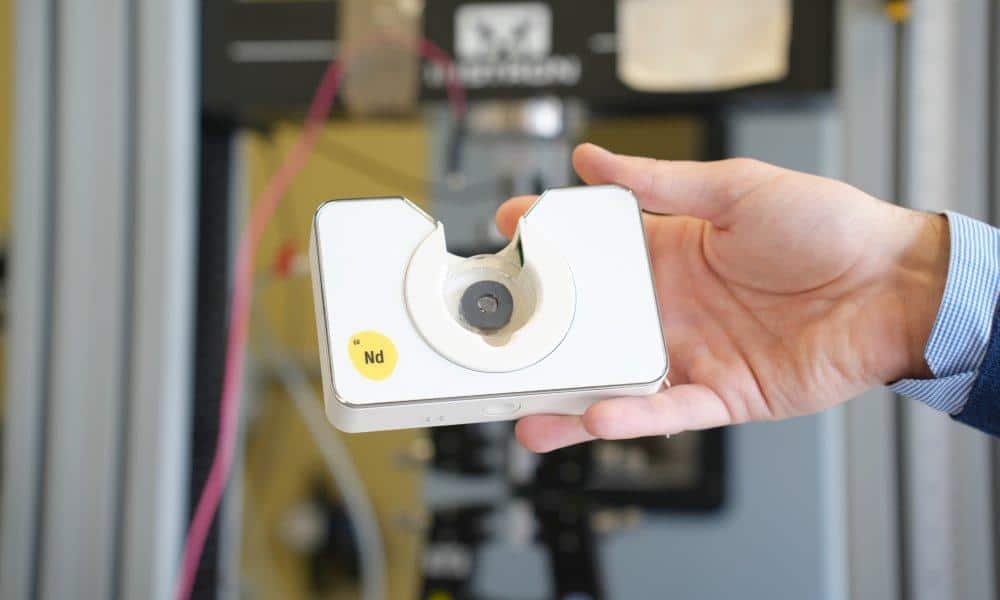
By using an intelligent material (sensitive to magnetic fields), NeoMag allows a non-invasive, multidimensional and real-time control of mechanical stresses and deformations.

Thanks to precise mechanical environmental control over the cellular substrate, NeoMag is able to simulate 2D and 3D complex cellular environments such as tumoral development, tissue recovery or cerebral cells.

We have developed NeoMag to be used with conventional imaging systems, so it can be easily integrated with regular instrumentation and lab equipment.

Adaptation to any conventional imaging system

Integration with other instrumental equipment (e.g. nanoindenters)

Suitable for 2D and 3D biological systems
By using the NeoMag technology, researchers can envision new frontiers integrating new data layers to their results.
Open and develop new research lines
Access to new structural data and behaviour of cells and bio tissues
Be at the forefront of the mechanobiology specialization

The NeoMag technology provides insightful information about how new drug developments react to certain cell and tissue deformations, creating new paths for drug discoveries or narrowing your successful candidates pipeline.
Reduce drug development time and cost
Reduce risk on the clinical trial phase
Increase therapy quality and efficiency





Funded by the European Union. Views and opinions expressed are however those of the author(s) only and do not necessarily reflect those of the European Union or the European Innovation Council and SMEs Executive Agency (EISMEA). Neither the European Union nor the granting authority can be held responsible for them.
This project has received funding from the European Innovation Council under the European Union's Horizon Europe research and innovation programme (EIC Transition, Grant Agreement No. 101284471).